
Federal wildfire plans are bad for Utah
UPHE’s Dr. Brian Moench co-authored an opinion piece in the Salt Lake Tribune that addressed federal plans that have real impacts on Utah. On the heels of one of our worst fire seasons, management and the associated health effects are important to look at.
Find the full opinion piece in the Salt Lake Tribune here.
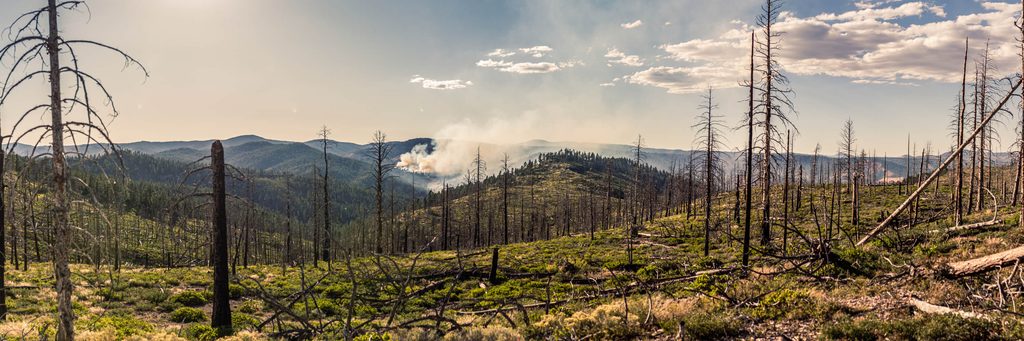
The U.S. Forest Service has a long history of heavy-handed forest management sold to the public as wildfire mitigation. We see the landscape degradation of that heavy hand whenever we hike through the Wasatch Mountains. When the taxpayer-funded bullhog masticators ripped through Parley’s Canyon in the early June 2023 Watershed Restoration Initiative Project, it was peak nesting season. We saw hundreds of nesting bird sites destroyed before the fledglings had a chance to fly. The protective oak stand cover for animals accessing Utah’s first dedicated wildlife bridge over I-80 was shredded with the debris left onsite, and then it was sprayed with toxic chemicals. Two years later, the dried and shredded material remains and is more likely to ignite than live vegetation. This was all in the watershed, of course.
This forest and wildlife destruction will spread throughout the West if the U.S. Senate passes Sen. John Curtis’s ironically named “Fix Our Forests” Act (FOFA), or if the Trump Administration succeeds in opening up millions of acres of our national forests to logging by rescinding the roadless rule.
As conservation professionals, we believe these two cures for wildfires are false solutions that are likely to backfire (pun intended).
Of course, we want protection from wildfires, but what FOFA and eliminating the Roadless Rule will do instead is put many homeowners at even greater risk. Both measures guarantee even more degradation of forests and grasslands through industrial logging and livestock grazing. They undermine bedrock environmental laws like the Endangered Species Act and the National Environmental Policy Act, worsen the climate crisis (which research shows is the real cause of increased wildfires), and threaten public health.
Both measures walk in lockstep with the Trump administration’s executive order to expand American timber production. Rescinding the roadless rule will devastate some of the nation’s most pristine forests, and advances a pseudo “emergency” logging designation across 112 million acres — 59% of national forests.
While both measures pretend to be about “protecting communities,” the consensus of peer-reviewed science supports home hardening as the only way to save homes and lives, including those of firefighters — not logging or grazing miles away from homes.
As one Forest Service-funded study admits, “fuel treatments are not designed to prevent or stop fires but to moderate fire behavior when fire inevitably returns. However, there is a frequent misconception that fuel treatments should facilitate suppression and limit the size of wildfires.”
FOFA’s insistence on logging millions of acres — such as in Utah’s Big Cottonwood Canyon and Pine Valley — to allegedly “reduce the risk of wildfire” also rings hollow under scientific scrutiny. As Reilly et al. (2022) explain, “Adaptation strategies for similar fires in the future could benefit by focusing on ignition prevention, fire suppression, and community preparedness, as opposed to fuel treatments that are unlikely to mitigate fire severity during extreme weather.”
Studies show that thinning forests results in “increased susceptibility of thinned stands to fire spread from higher sub-canopy wind speeds and increased fine fuels (slash).” An unfortunate example is the Cottonwood Fire that burned straight through dozens of “fuel treatments” and ski runs that are generally considered “fuel breaks.”
Both measures also increase opportunities to utilize livestock grazing as a wildfire risk reduction strategy, a claim unsupported by science. Wildfire research shows that protecting homes depends most on the home ignition zone, which includes the structure and the vegetation immediately surrounding it. Research from the International Journal of Wildland Fire found that the most effective defensible space treatments were only 16 to 58 feet from the structure with no added protection beyond 100 feet.
Road building is proven to increase wildfire risk. Research shows forest land within 50 meters of a road is five times more likely to be the site of a wildfire compared to wilderness. Livestock grazing and road building can also increase long-term fire risk by disturbing soils and native vegetation in ways that favor invasive annual grasses such as cheatgrass, which dries out early in wildfire season and is far more flammable than native grasses.
Unfortunately, these measures are not only a threat to public lands but to public health. While some wildfire smoke is inevitable, land management agencies’ practice of pile burning logging slash spews out dozens of dangerous toxins, research shows. This includes not just woodsmoke but toxins from chemical accelerants, plastic used to cover slash piles and routine landscape-scale spraying of toxic herbicides.
The claim that human health is “protected” by intentional burns is dangerous mythology. One study found that more people die from inhaling smoke from intentional burning than unintentional wildfires. Another study found that per hectare burned, the health burden and daily health care costs are nearly five times higher for intentional burns compared to wildfires.
Passing FOFA and rescinding the roadless rule will degrade and destroy public lands, harm public health, aggravate the climate crisis and ironically increase the risk of embers and flames spreading to communities.
Ask our politicians to follow the science and oppose both measures.