
HF Sinclair’s draft maps route a new fuel pipeline through Salt Lake City’s watershed, down Emigration Canyon and across the city to North Salt Lake. Emigration Canyon residents Mobilizing to Oppose the Plan
This is Not the place, the risks are unacceptable
WHAT: Emigration Canyon Council Meeting to discuss – the “Westline Connect” gas pipeline down Emigration Canyon putting drinking water for nearly 400,000 people at risk. Residents to raise the issue during public comments.
WHEN: Tuesday October 20th 7:00 PM
WHERE: Emigration Canyon Fire Station (Unified Fire Authority Station 119)
5025 Emigration Canyon Rd, Salt Lake City, UT 84108
The Issue:
For many years HF Sinclair has shipped refined fuel from a Wyoming refinery to Salt Lake City along an established pipeline through rural Summit, Morgan and Davis counties. Now it wants more capacity in response to an opportunity to sell more product in Nevada and California due to scheduled refinery closures in California. On its July 28 earnings call, the company’s president told investors that “the reason we’re doing this is the tightness in PADD 5,” the West Coast fuel market, with the first phase moving about 35,000 barrels a day west into Nevada and, longer term, into California. Utah already refines more fuel than it uses.
“Why carve a new gasoline pipeline corridor through Salt Lake City’s protected watershed and along Emigration Canyon’s only road out before proving the existing Pioneer corridor can’t be upgraded or expanded? HF Sinclair already co-owns the Pioneer pipeline through Morgan County. Before the Legislature overrides local decisions or affects landowners’ rights, require the company to put the engineering, capacity, costs and environmental risks of both alternatives on the table—and show why upgrading the existing corridor won’t work,” said Robert Macfarlane, Emigration Canyon resident.
“The future of our city and the people who live here does not depend on gasoline pipelines. It depends on clean water. We can never compromise that and the health of our citizens,” said Kirtly Jones, Emigration Canyon resident and board member of Utah Physicians for a Healthy Environment.
What we know:
- Refined petroleum is different from crude oil. In addition to being harder to clean up, it is significantly more volatile and flammable. According to a presentation by the company to Salt Lake City Council, this pipeline could carry gasoline, diesel, and jet fuel.
- HF Sinclair has not shown how much of this fuel would stay in Utah, yet we have to live with the environmental and public health risks that come with the project. HF Sinclair’s October 2025 investor announcement clearly states “This initiative is designed to address the increasing supply and demand imbalances in key western markets, particularly Nevada and multiple markets in California.” Despite claims by HF Sinclair to local communities, it has not been demonstrated that this gas line would lower fuel prices for those impacted by the project.
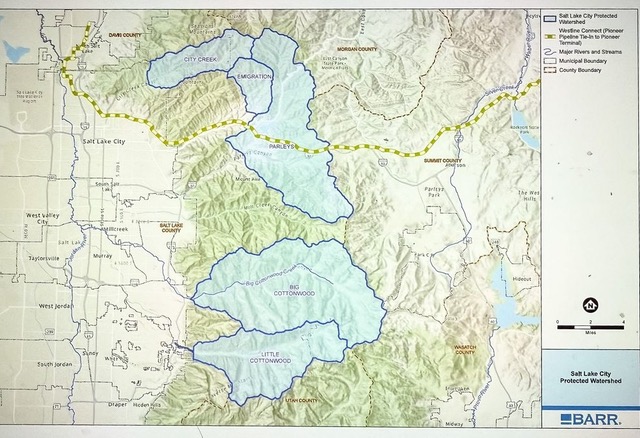
- No formal alignment has been released, though HF Sinclair survey crews have been active in Emigration Canyon. Draft maps prepared by HF Sinclair’s consultant and provided to Salt Lake City for its Oct. 13 briefing, since published by KPCW, show the pipeline running through miles of protected watershed in Parley’s Canyon, down the entirety of Emigration Canyon, across Salt Lake City Foothills, then punching through The Avenues, Capitol Hill, Marmalade, and Rose Park neighborhoods.
- There is an existing refined petroleum pipeline in Weber Canyon, the Pioneer Pipeline. HF Sinclair co-owns this pipeline with Phillips 66, which operates it, and is framing the new “Westline Connect” proposal as an expansion of that line. Despite the new proposal being approximately 20 miles longer, and exposing hundreds-of-thousands of additional people to associated risks, the company would rather build a new pipeline rather than temporarily close and expand their existing pipeline.
Risks associated with this project:
- Watershed Risks: To access Emigration Canyon from the East, an alignment would likely need to cross protected Salt Lake City Watershed in Parley’s Canyon. An accident in this area could severely impact hundreds-of-thousands of downstream water users. Though surface water in Emigration Creek is not widely diverted for culinary or irrigation uses, this project risks the water in private wells, along with downstream impacts to the Jordan River and Great Salt Lake.
- Urban Fire and Spill Hazard: To extend westward towards the end destination, one can assume that this pipeline would need to continue through or above Salt Lake City. A spill in this region could be a significant public safety risk for residents within urban areas.
- Wildfire Hazard: This proposal travels through areas rated as “Extreme” wildfire danger rating by the state of Utah. A pipeline rupture could ignite a fire with potential to travel long distances at high-severity, risking not only Emigration and Parley’s Canyons, but the entire Wasatch Range. A significant portion of Emigration Canyon also lies within the High Risk Wildland Urban Interface (WUI) boundary. As taxpayers and homeowners work to reduce wildfire risk in response to H.B. 48 (2025), this proposal would increase wildfire risk in the very same area.
- Single Access & Evacuation Route: Emigration Canyon Road is the sole access and evacuation route for the entire canyon. A spill or fire along this route could block emergency vehicles and trap residents with no alternate egress. Constructing a fuel line alongside or underneath the only roadway could create severe emergency response and access risks.
- Geologic Hazard: This proposal would need to cross the Wasatch Fault, which has an 18% chance for one or more Magnitude ≥ 6.75 earthquakes occurring over the next 50 years. Aside from vague claims of “new industry standards” presented to the Salt Lake City Council, no additional information has been provided about how the single-wall pipe could withstand such an incident.
Back Ground:
The draft route on HF Sinclair’s maps (see attached map) should be alarming to virtually all residents, businesses, and institutions in the NortheastQuadrant of Salt Lake City, and the 400,000 residents that depend on the Parley’s and Emigration Canyons/Mountain Dell water shed. It is even more alarming for the 300 households in Emigration Canyon who are completely dependent on private wells for water. The route crosses the foothills of Salt Lake City, above the University of Utah and Huntsman medical center complex, City Creek, and the neighborhoods of Ft. Douglas, Federal Heights, and lower avenues.
The proposed route crosses protected, critical watershed in both canyons. It is not hyperbole to say that every fossil fuel pipeline eventually leaks somewhere. Since 2010, the US Pipeline and Hazardous Materials Safety Administration (PHMSA) has counted 9,329 fossil fuel pipeline leaking incidents, an average of at least 1.7 events per day. Even that official statistic is a vast underestimation, because Texas alone reports an average ofnearly 30 pipeline leaks per day.
These statistics should not be an abstraction or theoretical risk to residents of Salt Lake City. In 2010, two oil spills six months apart from a Chevron pipeline rocked the city. In the first spill, 33,600 gallons of crude oil escaped from a half inch hole in a 10 inch pipe and poured down Red Butte Creek, smothered Liberty Park Pond and continued into the Jordan River. Chevron did not respond to the leak for over 10 hours, and it took another 10 hours before they could get the pipeline shut down. The encore released 21,000 gallons of Chevron oil–same pipeline, same area.
While the environmental harm of Red Butte Creek, Liberty Park Pond, and the Jordan River smothered with oil was obvious, tragic, and long lasting, the human health consequences were even more so. People with homes on the creek were sickened by the toxic vapors and had multiple symptoms for years afterwards. A fatal lung disease and leukemia in two of the most exposed healthy adult males are highly likely to have been directly caused by the oil spill. Cancer rates among exposed residents is currently being tracked by the Salt Lake County Health Dept. Water sampling over a year later still found carcinogenic chemicals in some spots 400 times higher than the EPA’s “acceptable limits.”
People exposed to VOCs (volatile organic compounds) from oil and gasoline spills show decreased lung function, more lung scarring, impaired heart and liver function, abnormal blood counts, and are plagued by chronic symptoms like headache, shortness of breath, skin rash, cough, fatigue, painful joints, and chest pain that can persist for years. But the most vulnerable targets are the brain, bone marrow, and chromosomes. Damage can be permanent.
Gasoline penetrates soil and subsurface geologic formations more easily than crude oil risking contaminating ground water and well water. One gallon of spilled gasoline could contaminate 1 million gallons of water in a reservoir like East Canyon, or Rockport as well as acres of soil. Gasoline is far more flammable than oil, its vapor is explosive, adding greatly to fire risk in a canyon like Emigration with only one exit road and an “extreme” fire risk rating.
The benefits of this pipeline are exclusive to Sinclair, but the risks to Utah are substantial, unacceptable, and could be incalculable in a worst-case scenario. Moreover, Sinclair has other less risky options to reach the California market. This proposal should be considered a non-starter for local and state officials, and virtually all Salt Lake City residents.