
Inland Port – it’s time to get involved
The Utah Inland Port has been under heavy scrutiny lately with change in leadership, questionable spending of public funds, and an unconvincing business plan. There are so many issues and concerns with the Port that it can be difficult to keep up.
Fred Ash had an excellent, straight-forward letter in the Salt Lake Tribune, going back to the conception of the Utah Inland Port. His letter provides a clear breakdown of events for those that are just hearing about all of the controversy with the Port, and looking to get involved.
“The Inland Port Authority and inland port were created as legal entities by the Utah State Legislature, in bill SB234 in 2018. The boundaries of the port in the northwest quadrant of the Salt Lake valley were first spelled out at that time, amounting to about 16,000 acres. In 2019, HB0433 significantly broadened the Inland Port Authority’s reach to approximately one-third of Salt Lake City’s land area. Because the area included several municipalities, our legislature felt that for it to succeed it must be an independent entity, not bound by public input, and with independent taxing authority. The approved Utah Inland Port Authority is in essence a government-run corporation that could be called a “city/state” with the responsibility and legal powers to develop and run the Inland Port in all ways, including finances, without public input.”
Our partner on the Stop the Polluting Port (STPP) coalition, Deeda Seed, was also featured in the Tribune last week. She reminds us that we were promised a green port and progressive technology early on in this battle, and to not let our guard down in light of new promises.
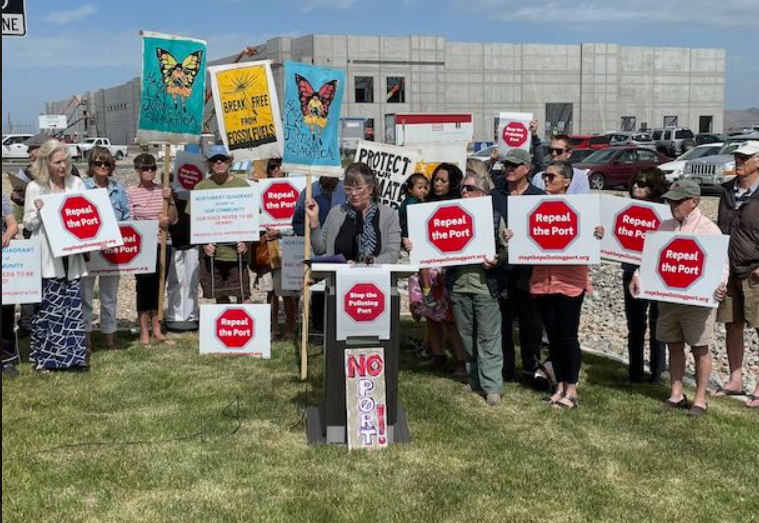
“Years ago, after the concerned community found out about the tax breaks being offered to Rio Tinto and Colmena by the Salt Lake City Redevelopment Agency, we showed up at city hall en masse before a final vote to ask that they be stopped. Representatives of the warehouse developers scoffed at us claiming that their warehouses were going to be built in an environmentally friendly way with solar panels on the roofs.
Fast forward to today, and there is nothing environmentally friendly about what’s being built. There are no solar panels, no state-of-the-art stormwater pollution prevention, no sustainable building design, just one gigantic polluting subsidized warehouse after another,” Seed wrote of the previous broken promises.
“The contract language also requires that UIPA conduct a health impact assessment, a traffic study and a community impact assessment…
Theoretically these assessments and plans, along with input from a yet-to-be-created advisory board, will be used to develop priorities for environmental mitigation expenditures ostensibly intended to mitigate the harm that will come from as much as 152 million square feet of new warehouse development…
The problem with this new effort is that UIPA still has the final say on how the money will be spent. Salt Lake City and other local governments included in the UIPA jurisdiction no longer have voting members on the UIPA Board. So, there is a plausible scenario whereby the assessments and plans are poorly executed without adequate metrics and a scatter shot of poorly funded environmental mitigation measures are adopted, after which UIPA declares success.”
Read the full letters:
In light of ongoing complaints about the inland port, here’s a reminder of how we got here
Fred Ash in the Salt Lake Tribune
Keep a close watch on the Utah Inland Port Authority’s ‘do-over’
Deeda Seed in the Salt Lake Tribune